
Mock Water Billing
Volumetric Billing has begun in North and South Pender Harbour! Learn more here.
Residents on the Eastbourne, Langdale, Chapman, Egmont, Cove Cay Water Systems can expect their second mock bill to land in November, 2026.
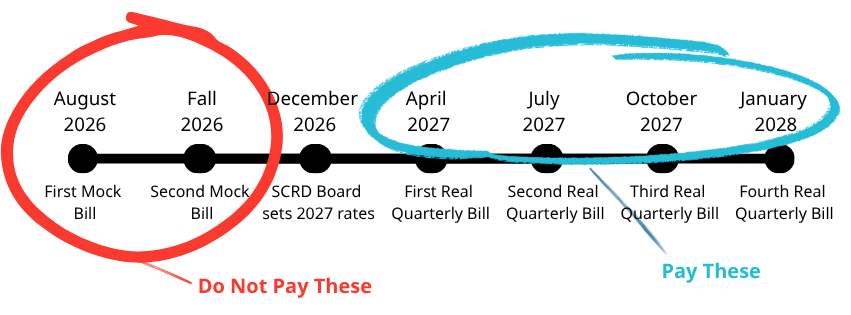
A timeline for billing on the Regional Water Service is below. Not sure which water system serves your property? Enter your address on this map to find out.
Project Background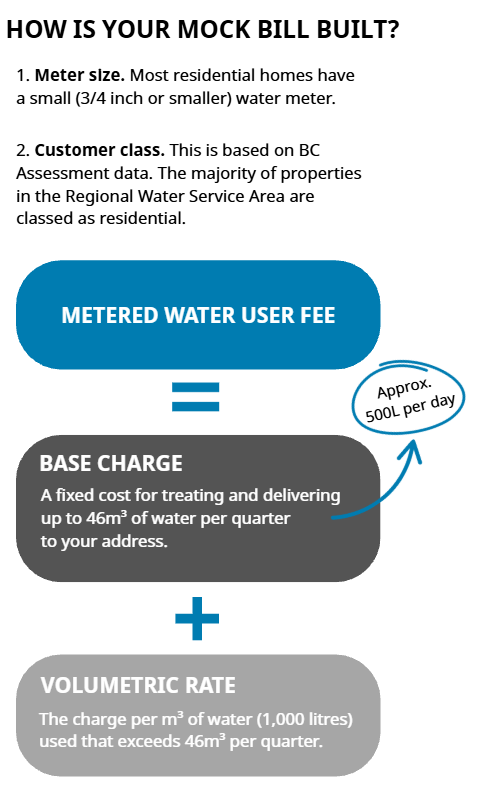
Since 2013, the Sunshine Coast Regional District (SCRD) has been working to install water meters at all properties within SCRD Water Service Areas.
In late 2026, the SCRD is anticipated to complete water meter installations in the Sechelt area.
The next step following metering is the introduction of a new way of billing for water known as volumetric billing.
Up until now, SCRD regional water service customers have paid a flat rate for water. The volumetric billing project will introduce a new way of billing for SCRD water customers that will result in some charges on your bill based on your water use. This method of billing can help encourage conservation, ensure fair pricing and cover the costs of maintaining and upgrading SCRD water systems.
This is your space to learn more about your mock volumetric bill.
On this page you can:
- Check out the timeline on the project (on the right on desktop, or below if accessing on mobile phone)
- Read the most common questions asked about the project
- See an explainer of content on your mock bill.
Below
Ask questions about the project. Please check out the common questions first as the answer to your question could be there!
Volumetric Billing has begun in North and South Pender Harbour! Learn more here.
Residents on the Eastbourne, Langdale, Chapman, Egmont, Cove Cay Water Systems can expect their second mock bill to land in November, 2026.
A timeline for billing on the Regional Water Service is below. Not sure which water system serves your property? Enter your address on this map to find out.
Project Background
Since 2013, the Sunshine Coast Regional District (SCRD) has been working to install water meters at all properties within SCRD Water Service Areas.
In late 2026, the SCRD is anticipated to complete water meter installations in the Sechelt area.
The next step following metering is the introduction of a new way of billing for water known as volumetric billing.
Up until now, SCRD regional water service customers have paid a flat rate for water. The volumetric billing project will introduce a new way of billing for SCRD water customers that will result in some charges on your bill based on your water use. This method of billing can help encourage conservation, ensure fair pricing and cover the costs of maintaining and upgrading SCRD water systems.
This is your space to learn more about your mock volumetric bill.
On this page you can:
- Check out the timeline on the project (on the right on desktop, or below if accessing on mobile phone)
- Read the most common questions asked about the project
- See an explainer of content on your mock bill.
Below
Ask questions about the project. Please check out the common questions first as the answer to your question could be there!
Ask a Question about Volumetric Billing.
Check out the Frequently Asked Questions. If you still have a question, ask it below!
-
Share Has the SCRD considered seasonal rates for the fall and winter, when water is abundant? I understand the meters are meant to encourage conservation, which makes sense in the dry summer months, but in the wet months it seems odd to charge excess usage at the same rate. on Facebook Share Has the SCRD considered seasonal rates for the fall and winter, when water is abundant? I understand the meters are meant to encourage conservation, which makes sense in the dry summer months, but in the wet months it seems odd to charge excess usage at the same rate. on X (formerly Twitter) Share Has the SCRD considered seasonal rates for the fall and winter, when water is abundant? I understand the meters are meant to encourage conservation, which makes sense in the dry summer months, but in the wet months it seems odd to charge excess usage at the same rate. on Linkedin Email Has the SCRD considered seasonal rates for the fall and winter, when water is abundant? I understand the meters are meant to encourage conservation, which makes sense in the dry summer months, but in the wet months it seems odd to charge excess usage at the same rate. link
Has the SCRD considered seasonal rates for the fall and winter, when water is abundant? I understand the meters are meant to encourage conservation, which makes sense in the dry summer months, but in the wet months it seems odd to charge excess usage at the same rate.
Kelly asked 3 days agoHi,
Collecting, treating, storing, and distributing water has a cost. Water efficiency is a year-round objective focused on making the best use of the water we have, while keeping short and long-term service costs sustainable, by reducing demands on infrastructure and the need for premature capital investments.
The SCRD has chosen a gradual approach in transitioning to volumetric rate structures to help customers change their behaviours while increasing their water literacy. A gradual approach also ensures that the overall cost of providing the water service stays sustainable as customers adjust.
In the first years, the SCRD is using a base rate and consumption allowance to recover most costs in a fixed or ‘guaranteed’ way, with a smaller amount of variable costs recovered through volumetric rates.
After a few years of volumetric billing and subject to Board direction, different rate structures, including changes in the fixed to variable cost recovery ratios, threshold of consumption allowance, tiered or seasonal rate structures may be considered.
Thanks for your question.
-
Share Given that half of water users are below the base rate, this half has no incentive for conservation while subsidizing high volume users. Why can there not be a maximum rate charged for those below the base. Rather than my having to pay 3 times the normal rate at $10/m3 for my usage, a max rate of $5 would be more fair while still contributing to system costs and putting more pressure on high volume users for conservation. This half using more than the base have the greatest potential for impact on supply challenges. on Facebook Share Given that half of water users are below the base rate, this half has no incentive for conservation while subsidizing high volume users. Why can there not be a maximum rate charged for those below the base. Rather than my having to pay 3 times the normal rate at $10/m3 for my usage, a max rate of $5 would be more fair while still contributing to system costs and putting more pressure on high volume users for conservation. This half using more than the base have the greatest potential for impact on supply challenges. on X (formerly Twitter) Share Given that half of water users are below the base rate, this half has no incentive for conservation while subsidizing high volume users. Why can there not be a maximum rate charged for those below the base. Rather than my having to pay 3 times the normal rate at $10/m3 for my usage, a max rate of $5 would be more fair while still contributing to system costs and putting more pressure on high volume users for conservation. This half using more than the base have the greatest potential for impact on supply challenges. on Linkedin Email Given that half of water users are below the base rate, this half has no incentive for conservation while subsidizing high volume users. Why can there not be a maximum rate charged for those below the base. Rather than my having to pay 3 times the normal rate at $10/m3 for my usage, a max rate of $5 would be more fair while still contributing to system costs and putting more pressure on high volume users for conservation. This half using more than the base have the greatest potential for impact on supply challenges. link
Given that half of water users are below the base rate, this half has no incentive for conservation while subsidizing high volume users. Why can there not be a maximum rate charged for those below the base. Rather than my having to pay 3 times the normal rate at $10/m3 for my usage, a max rate of $5 would be more fair while still contributing to system costs and putting more pressure on high volume users for conservation. This half using more than the base have the greatest potential for impact on supply challenges.
Bil asked 4 days agoHi, thanks for your feedback.
This initial approach to volumetric billing looks to ease the community into the new way of billing. Customers using less than 46m3 could see a small savings in their water utility rates compared to how they were billed under the flat rate approach ($750 yearly), and higher water users can adapt to the new structure which more fairly distributes costs based on how much water they use. Actual 2027 rates will be considered by the SCRD Board on December 3, 2026.
In the future, there will likely be adjustments to how the base rate and volumetric rate are applied (such as lowering the base rate allowance or increasing the volumetric rate) with the objective of fairer billing, greater water use efficiency and while maintaining stable revenue recovery to cover the costs of operating the water system.
-
Share Since the water meters are so precise recording usage why can't the specifically charge for usage only? If repayment is needed for installation of meter system designate that quarterly charge until paid off. on Facebook Share Since the water meters are so precise recording usage why can't the specifically charge for usage only? If repayment is needed for installation of meter system designate that quarterly charge until paid off. on X (formerly Twitter) Share Since the water meters are so precise recording usage why can't the specifically charge for usage only? If repayment is needed for installation of meter system designate that quarterly charge until paid off. on Linkedin Email Since the water meters are so precise recording usage why can't the specifically charge for usage only? If repayment is needed for installation of meter system designate that quarterly charge until paid off. link
Since the water meters are so precise recording usage why can't the specifically charge for usage only? If repayment is needed for installation of meter system designate that quarterly charge until paid off.
Robert Lister asked about 2 months agoThanks for the question.
Water user fees cover the costs of operating the water system, including things such as the management of source water, treatment, pumping, and regular maintenance for the delivery of water – these costs will always continue and are recovered each year through user fees. The SCRD is gradually transitioning to volumetric billing through the rate structure that was chosen to promote water efficiency, limit the risk to revenue sufficiency to cover the costs of operating the system and to give the public adequate opportunity to adjust to the new rate structure. In other words, SCRD still needs to cover the costs of operating the water system, and the Base Allowance helps gives that certainty. Read more about the rate structure here.
In the future, there may be adjustments to how the base rate and volumetric rate are applied (which could mean being more reliant of volumetric usage) with the objective of fairer billing, greater water use efficiency and while maintaining stable revenue recovery to cover the costs of operating the water system.
-
Share Hi folks, I received my first mock-up bill. I will say, that I'm not thrilled with a baseline amount to be charged to all households. My household consumed half of the baseline amount, and we work hard at conserving water in our household. For us to have to pay the same rate as those who consume twice the amount we do doesn't seem fair or proportionate. You should be rewarding those who are under the baseline and charging a fair and representative price for those who go beyond it. on Facebook Share Hi folks, I received my first mock-up bill. I will say, that I'm not thrilled with a baseline amount to be charged to all households. My household consumed half of the baseline amount, and we work hard at conserving water in our household. For us to have to pay the same rate as those who consume twice the amount we do doesn't seem fair or proportionate. You should be rewarding those who are under the baseline and charging a fair and representative price for those who go beyond it. on X (formerly Twitter) Share Hi folks, I received my first mock-up bill. I will say, that I'm not thrilled with a baseline amount to be charged to all households. My household consumed half of the baseline amount, and we work hard at conserving water in our household. For us to have to pay the same rate as those who consume twice the amount we do doesn't seem fair or proportionate. You should be rewarding those who are under the baseline and charging a fair and representative price for those who go beyond it. on Linkedin Email Hi folks, I received my first mock-up bill. I will say, that I'm not thrilled with a baseline amount to be charged to all households. My household consumed half of the baseline amount, and we work hard at conserving water in our household. For us to have to pay the same rate as those who consume twice the amount we do doesn't seem fair or proportionate. You should be rewarding those who are under the baseline and charging a fair and representative price for those who go beyond it. link
Hi folks, I received my first mock-up bill. I will say, that I'm not thrilled with a baseline amount to be charged to all households. My household consumed half of the baseline amount, and we work hard at conserving water in our household. For us to have to pay the same rate as those who consume twice the amount we do doesn't seem fair or proportionate. You should be rewarding those who are under the baseline and charging a fair and representative price for those who go beyond it.
Sophia asked 3 months agoHello, thanks for the feedback.
Residents that use under the Base Allowance of 46m3 are only charged the Base Charge amount. This initial approach looks to ease the community into volumetric billing. It means that customers using less than 46m3 should see a small savings in their water utility rates compared to how they were billed under the flat rate approach ($750 yearly), and higher water users can adapt to the new structure which more fairly distributes costs based on how much water they use. You may be surprised to know that more than about half of all properties went over the Base Allowance this past quarter. There are still many residents who are not aware of how much water they use.
In the future, there may be adjustments to how the base rate and volumetric rate are applied (which could potentially mean lowering the base rate allowance) with the objective of fairer billing, greater water use efficiency and while maintaining stable revenue recovery to cover the costs of operating the water system.
-
Share My understanding is that the Base fee is a fixed fee, regardless what the water use is and that fee is $162.50 per quarter. How come that my mock Utility Bill has a Base fee of $341.25? on Facebook Share My understanding is that the Base fee is a fixed fee, regardless what the water use is and that fee is $162.50 per quarter. How come that my mock Utility Bill has a Base fee of $341.25? on X (formerly Twitter) Share My understanding is that the Base fee is a fixed fee, regardless what the water use is and that fee is $162.50 per quarter. How come that my mock Utility Bill has a Base fee of $341.25? on Linkedin Email My understanding is that the Base fee is a fixed fee, regardless what the water use is and that fee is $162.50 per quarter. How come that my mock Utility Bill has a Base fee of $341.25? link
My understanding is that the Base fee is a fixed fee, regardless what the water use is and that fee is $162.50 per quarter. How come that my mock Utility Bill has a Base fee of $341.25?
Petra asked 3 months agoHello,
The Base Rate amount is scaled based on the size of the water service connection and size of the water meter. Without knowing your exact address, it would appear that your property is serviced via a 1.5”-2” service based on the fee on your mock bill.
You can read more about how the mock bill rates were established, here.
If you have more questions about your specific property, please reach out to infrastructure@scrd.ca and we can help.
-
Share Does the new bill include water consumption and garbage pick up or just water? on Facebook Share Does the new bill include water consumption and garbage pick up or just water? on X (formerly Twitter) Share Does the new bill include water consumption and garbage pick up or just water? on Linkedin Email Does the new bill include water consumption and garbage pick up or just water? link
Does the new bill include water consumption and garbage pick up or just water?
Nick asked 3 months agoHello,
The mock bill that was just mailed to residents only includes the water consumption for educational purposes. In 2027, the annual SCRD utility bills will move to be on a quarterly basis. If you receive water, curbside and/or wastewater services from the SCRD, you will see them all divided up onto the quarterly bill. Property taxes are administered by the Province and will still be on an annual basis.
-
Share What does the portion of our provincial property parcel tax identified on our annual property tax notice as “Sunshine Coast Reg Water Authority” pay for? There is a reference in a previous question to it being for larger capital projects related to water but no detail provided on what that would be? It appears that we are paying for water related capital projects and infrastructure via the SCRD metered billing. on Facebook Share What does the portion of our provincial property parcel tax identified on our annual property tax notice as “Sunshine Coast Reg Water Authority” pay for? There is a reference in a previous question to it being for larger capital projects related to water but no detail provided on what that would be? It appears that we are paying for water related capital projects and infrastructure via the SCRD metered billing. on X (formerly Twitter) Share What does the portion of our provincial property parcel tax identified on our annual property tax notice as “Sunshine Coast Reg Water Authority” pay for? There is a reference in a previous question to it being for larger capital projects related to water but no detail provided on what that would be? It appears that we are paying for water related capital projects and infrastructure via the SCRD metered billing. on Linkedin Email What does the portion of our provincial property parcel tax identified on our annual property tax notice as “Sunshine Coast Reg Water Authority” pay for? There is a reference in a previous question to it being for larger capital projects related to water but no detail provided on what that would be? It appears that we are paying for water related capital projects and infrastructure via the SCRD metered billing. link
What does the portion of our provincial property parcel tax identified on our annual property tax notice as “Sunshine Coast Reg Water Authority” pay for? There is a reference in a previous question to it being for larger capital projects related to water but no detail provided on what that would be? It appears that we are paying for water related capital projects and infrastructure via the SCRD metered billing.
SMR asked 3 months agoHello, thanks for the question.
The user fee (utility bill) is intended to cover operating costs associated with delivering water to your property (this includes things like water treatment equipment, well pumping costs or staffing). Parcel tax (land charge on property tax notice) is to offset more major capital projects, for example, building a new well, or replacing large sections of aging waterlines.
The capital projects the SCRD is working on each year change and are directed by the SCRD Board through the budget process and 2026-2030 Financial Plan
The budget process for 2027 will begin in December 2026. The SCRD shares information throughout the process to keep the public informed.
-
Share If I use less than 46 cm in a quarter is the unused volume carried over to the next quarter? on Facebook Share If I use less than 46 cm in a quarter is the unused volume carried over to the next quarter? on X (formerly Twitter) Share If I use less than 46 cm in a quarter is the unused volume carried over to the next quarter? on Linkedin Email If I use less than 46 cm in a quarter is the unused volume carried over to the next quarter? link
If I use less than 46 cm in a quarter is the unused volume carried over to the next quarter?
Curious asked 3 months agoHello,
The Base Charge use allowance of 46 cubic metres of water is per quarter and does not ‘roll over’ to the next quarter.
Major drivers of volumetric billing is to more fairly distribute costs among users, encourage water conservation during the dry seasons and support the long-term sustainability of local water sources.
-
Share Will the quarterly water billings be replacing the water portion currently charged on our annual utility bill? I sure hope the answer is yes. on Facebook Share Will the quarterly water billings be replacing the water portion currently charged on our annual utility bill? I sure hope the answer is yes. on X (formerly Twitter) Share Will the quarterly water billings be replacing the water portion currently charged on our annual utility bill? I sure hope the answer is yes. on Linkedin Email Will the quarterly water billings be replacing the water portion currently charged on our annual utility bill? I sure hope the answer is yes. link
Will the quarterly water billings be replacing the water portion currently charged on our annual utility bill? I sure hope the answer is yes.
Jean O'Connor asked 3 months agoHi, thanks for the question. You are correct.
The new Volumetric Billing rate structure will replace the existing flat rate method. It is not in-addition to. Once implemented, property owners can anticipate receiving a bill every three months, with the bill calculated by taking into account water usage.
-
Share What happened to the meters being to find leaks only? on Facebook Share What happened to the meters being to find leaks only? on X (formerly Twitter) Share What happened to the meters being to find leaks only? on Linkedin Email What happened to the meters being to find leaks only? link
What happened to the meters being to find leaks only?
Sarah asked 3 months agoHello, thanks for the question.
Water meters began being installed on the Sunshine Coast in 2014, and their purpose was always for connecting residents with their water use, finding leaks and for the eventual transition to volumetric billing. Now that all water services on the Coast are metered, the SCRD is bringing those aspects to reality in 2027 across all SCRD water service areas.



-
 Mock Bills
- Why did I receive this mock bill?
- Do I need to pay the mock bill?
- How are the bills calculated?
- What is a cubic meter (m³)?
- Why is my water usage so much higher in Q2?
- What does “continuous flow detected” mean?
- I have a secondary suite; how will my bill work?
- Why does the Regional District not meter and bill individual strata units?
- Can the Regional District send the Utility Bill to the tenant of the property instead?
-
Volumetric Billing
- When does volumetric billing start?
- When will my water bill change?
- How will my water use be measured?
- How accurate are water meters used for volumetric billing?
- How will the volumetric user fees be structured?
- What are Base Charges and the Volumetric Rate?
- Will there be a minimum charge under the new rate structure?
- How can I conserve water to lower my bill?
- My property is already charged a metered rate; how will my bill change?
- How often are meters read and bills issued?
- My leak is now resolved – am I eligible to receive an adjustment on my utility bill?
-
General Questions
- What is a water service area?
- What is volumetric billing?
- Why is the SCRD transitioning to volumetric billing?
- What factors impact the cost of water?
- Does this billing method apply to both residential and commercial users?
- I own a vacation home and am only here a few months of the year, does this apply to me?
-
Planning for introduction of volumetric billing
Mock Water Billing has finished this stageSCRD staff are meeting weekly to put a plan in place for volumetric billing in the North Pender, South Pender and Regional Water Service Areas.
This work includes setting the structure of the rates and developing a plan to communicate significant changes in billing to the community.
-
SCRD Board adopts the new rate structure
Mock Water Billing has finished this stageSpring 2025
-
2025 Mock Billing - North and South Pender Water Services
Mock Water Billing has finished this stageResidents in the North Pender and South Pender water service areas will receive mock volumetric bills. This 'mock bill' will show water use and what the water charges could be when a real bill is sent out.
2025
-
2026 Volumetric Billing Introduced in North and South Pender Water Services
Mock Water Billing has finished this stage2026
-
2026 Mock Billing - Regional Water Service
Mock Water Billing is currently at this stageResidents in the Regional Water Service will receive a mock volumetric bill. This 'mock bill' will show water use and what the charges could be when a real bill is sent out.
These mock bills will land with residents in August and later in fall in 2026.
-
April, 2027 Volumetric Billing introduced in Regional Water Service
this is an upcoming stage for Mock Water Billing2027
Thank you for your contribution!
Help us reach out to more people in the community
Share this with family and friends